
The accessibility of a space or service is based on countless small details that can make a difference in people’s real lives. One example is the latch on the doors of toilets, changing rooms, etc., which must have certain characteristics so that everyone can use them with the greatest possible degree of autonomy.
Have you ever thought about how a 5-year-old child opens a latch? or a person with arthritis? or a parent with a baby in her arms? Many people benefit from the presence of a latch chosen with accessibility criteria:
- People with reduced mobility need mechanisms that can be operated with only one hand, without complex movements or excessive force. In this section, we include those with arthritis, carpal tunnel or other hand and wrist conditions, as they find it difficult to squeeze, rotate or grip with their fingers.
- Visually impaired people need latches with high color contrast, differentiated reliefs or textures, and mechanisms that are easy to locate and understand by touch.
- People with intellectual or cognitive disabilities, or young children, require simple mechanisms with clear visual cues to help them understand and use the latch without frustration.
- People with temporary disabilities, who have suffered a fracture or sprain, or who are recovering from surgery also benefit from accessibility measures.
- The elderly, who combine diminished strength, dexterity, vision and balance, need latches with accessibility conditions.
- People holding objects or children benefit from a latch that can be easily operated with the elbow or without releasing what they carry makes everyday life easier.
How are the latches accessible?
Some of the aspects to be taken into account when choosing a latch that can be used in conditions of autonomy by all persons are, among others:
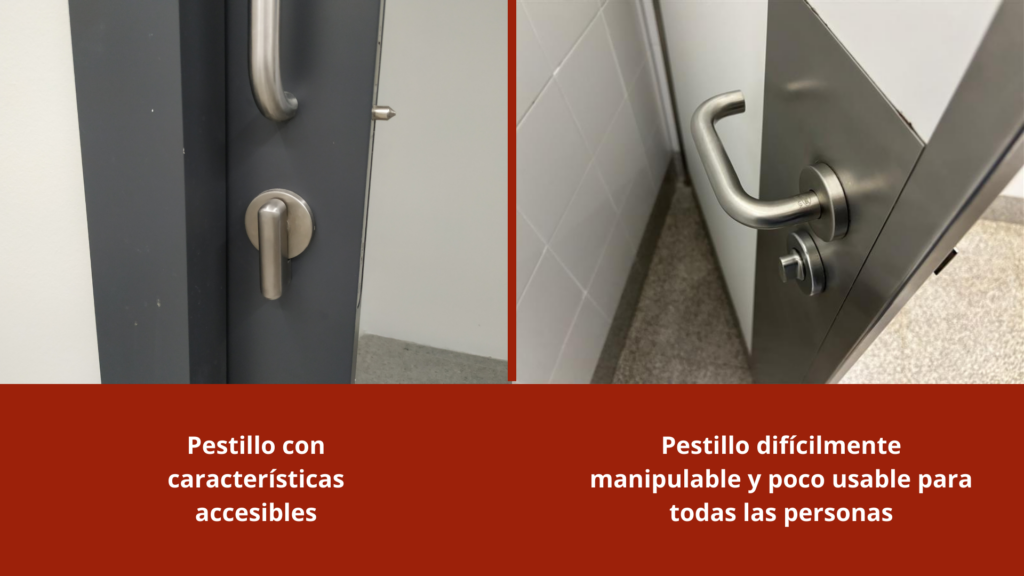
- Easy one-handed operation: It should not be necessary to use both hands or make complex movements. In fact, it should be possible to operate them with the elbow, palm or closed fist.
- Use with little force and without the need for fine movements: Use should be gentle and without the need to exert excessive force, as well as avoiding the need to pinch, twist or manipulate small parts. For example, lever mechanism, large button or bar.
- Ergonomic design: Comfortable to the touch surfaces, with recognizable shapes when felt.
- Safety and durability: It must be reliable and safe, without accidental loosening or requiring frequent maintenance.
- High visual contrast: It must be clearly differentiated from the door surface.
- Large and understandable visual indicators: Use of symbols, colors (red / green) or clear words (OPEN / CLOSED) in legible, contrasted and good size typography.
- Visible size: It should be large enough to be easily located and distinguished.
- Predictable location: It should be placed at the edge of the door, at a standardized height, where it can be expected to be found.
The AIS certificate has several specific requirements just to verify the accessibility conditions of a door latch, as well as its illumination and location.
How does AIS help you?
The AIS certificate takes into account all those little details that make the difference. The AIS 1/2023 standard verifies the accessibility conditions of all the physical and virtual elements that make up the space or the service provided in it. Among its more than 700 requirements, there are some specific requirements for bathrooms, toilets for ostomized people, lactation rooms… and all spaces where you must find an accessible latch.
The consultants or Approved Technicians help the beneficiary entities to achieve the highest degree of accessibility with AIS, evaluating the spaces and making recommendations for improvement of the different elements.

